Paulo Ciochetti is a visual artist based in São Paulo. A student of the Visual Arts course at Centro Universitário Belas Artes (2024), his work spans various languages, particularly painting and printmaking. He addresses themes such as memory, mediated remembrance, and the individual's connection to the past. He was an artist-in-residence at Canteiro—a contemporary art production space—between January and March 2024, and participated in the exhibition "Constelações Tangíveis" at Galeria 13 (2024).
How did your journey into the art world begin?
I have always enjoyed working creatively and seeing the work others develop for expressive purposes. I think of art as any form of sensitive communication between human beings, where the most diverse contents can be expressed.
My artistic process began in music, playing in several bands. I also explored cinema and theater; while I loved both languages, I missed having the autonomy to start and finish an artistic project alone. In 2020, certain that I would work with creativity, I began the Visual Arts course, which served as an essential formal introduction to the specific art market where I operate today.
How would you describe your artistic style?
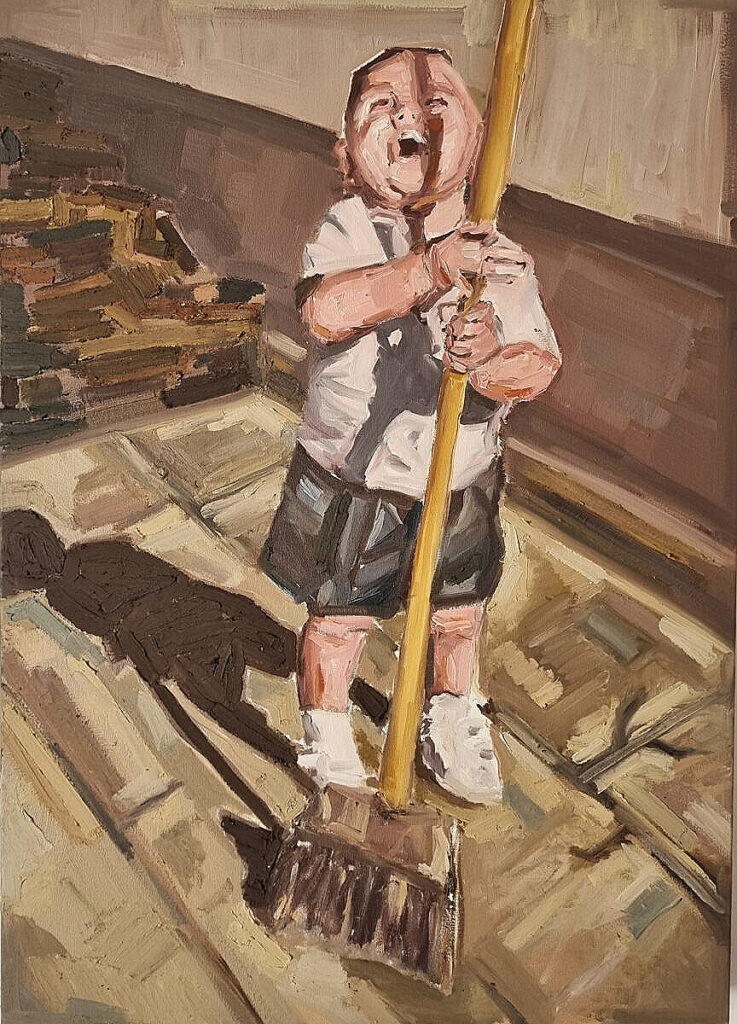
I think of my style as gestural, expressive, and intuitive. In my practice, I seek to represent figures from nature and daily life without hiding the marks of the language used in that representation. In other words, it is a style that considers photography not just as a reference for a scene, but as an object with its own visual characteristics that should also appear on the painted canvas. Thus, when painting, I do not seek to portray a moment, but rather the sensation of looking at a photograph of that moment years later.
In this investigation, I always look for the marks that the photographic medium leaves on the image—saturated regions, color spots that flatten the image, and all those "filters" or "sieves" that distance the photograph from the image "as perceived by the human eye." These are highlighted to create an autonomous painting.
What themes do you prefer to explore in your works?
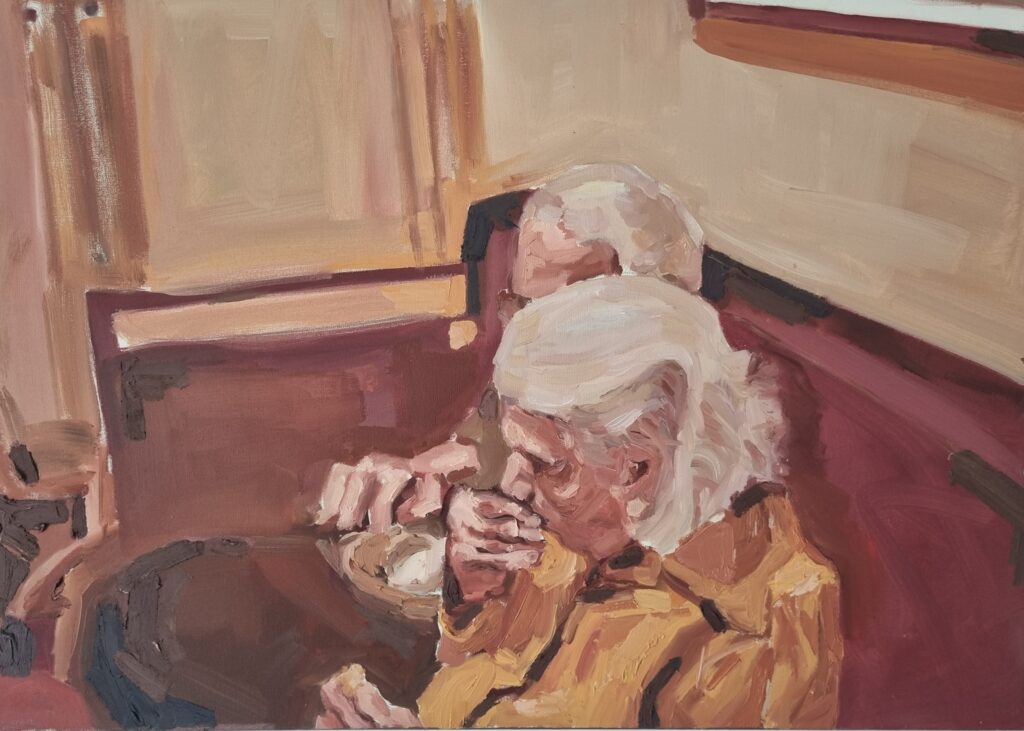
My research in oil paint seeks to build, from pre-existing images, an ambiguous and amorphous space analogous to the landscapes of memory. I think of each canvas as an image stuck on the retina after we close our eyes; a memory we try to recover without a visual reference, which becomes more distorted as we struggle to capture it.
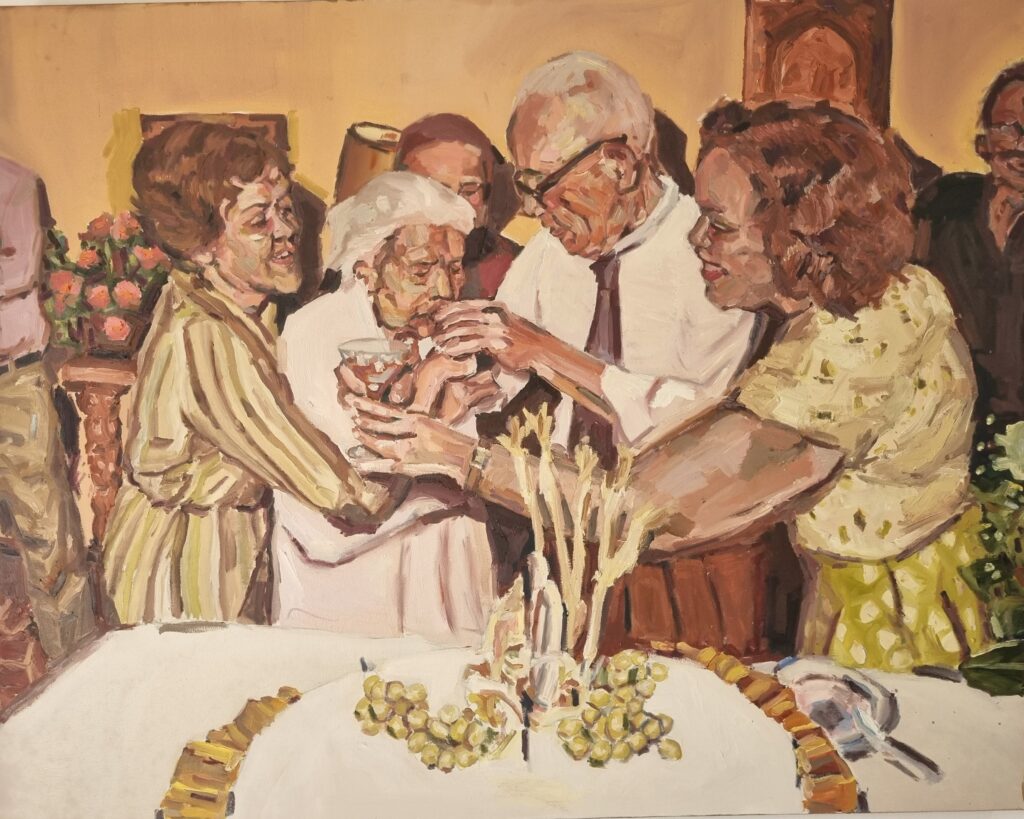
With this visuality, I intend to reach various sensations brought by the perception of the passage of time, such as nostalgia and saudade—even for a moment one did not live. I also think about the contrast between the comfort of the images portrayed and the tension provided by brushstrokes heavy with paint. I obtain canvases that evoke the feeling of looking at someone else's family album, where we recognize the scenes but with altered faces. I create an environment that moves between the comfortable and the claustrophobic; the familiar and the strange.
What is your creative process like?
My process tends to be quite chaotic—a struggle to gradually mold the image I see. I start with very diluted paint and make it more oily in the following layers. In the end, I have a work with a lot of texture, very marked brushstrokes, and varying levels of abstraction.
The clash between what I want to highlight and what I want to suppress remains marked on the canvas. Ultimately, I obtain an image that seems to be fading away, becoming increasingly elusive and blurred. The more I look at the figures I painted, the more the brushstroke and the texture of the paint become evident, and the more the color spots distort the depth of the image, reducing it to two-dimensional, flattened blurs.
What are your sources of inspiration?
There are several reasons I choose a specific reference for a work: the narratives in the scenes, interesting shapes, contrasts of light and shadow, or the distribution of elements in space. Sometimes, looking at a family album, I simply think a certain image would resolve well as a painting.
In general, however, I look for images that, when distorted by the expressiveness of the technique, cause some kind of estrangement. I also seek this estrangement through new croppings and framings that visually modify the narrative of the scene. I always think about how the image affects me the instant I see it. Where does my eye go? What attracts me? How do my previous experiences modify how the image reaches me?

What materials and techniques do you use most often?
To achieve a painting that possesses the characteristics of the reference photograph but also a high degree of gesturality, I explore the materiality of oil paint in different degrees of dilution. For the base and the innermost layers, I use paint heavily diluted with turpentine. As I progress, I use less thinner and the paint becomes thicker.
In the outermost layer, I often turn to cold encaustic. In this technique, a medium formed by beeswax and turpentine is added to the paint, which acquires a much denser consistency that can be molded with a brush or palette knife. This allows for the creation of very heavy spots of paint that jump off the canvas.
Who are the artistic influences that have impacted your work?
Regarding a poetics focused on materiality and dialogue with memory, I am inspired by artists like Anna Maria Maiolino and Rosana Paulino, who both link artistic objects with personal and social memory.
In terms of using oil painting to represent and distort daily scenes, I am heavily influenced by Noah Saterstrom and Mark Tennant, as well as the new European figuration of Luc Tuymans. In contemporary Brazilian art, I would cite Fátima Junqueira, Eduardo Berliner, and Marina Quintanilha as artists who use expressiveness to grant new layers of meaning to images ranging from historical memory to intimate recollections. In my view, these painters see the drawing of defined shapes as a "map" to guide the gesture, allowing expressiveness to manifest without hesitation.
How do you stay up to date on trends?
I believe the main way to stay updated in the art market is by frequenting contemporary art spaces such as shows, galleries, and independent exhibition spaces. Beyond knowing new cultural spaces, it is important to go to exhibitions of varied languages to perceive relevant themes and how different materials are addressed by artists today. These spaces also provide activities like workshops, lectures, or conversations with artists and curators that bring the public closer to artistic production.


