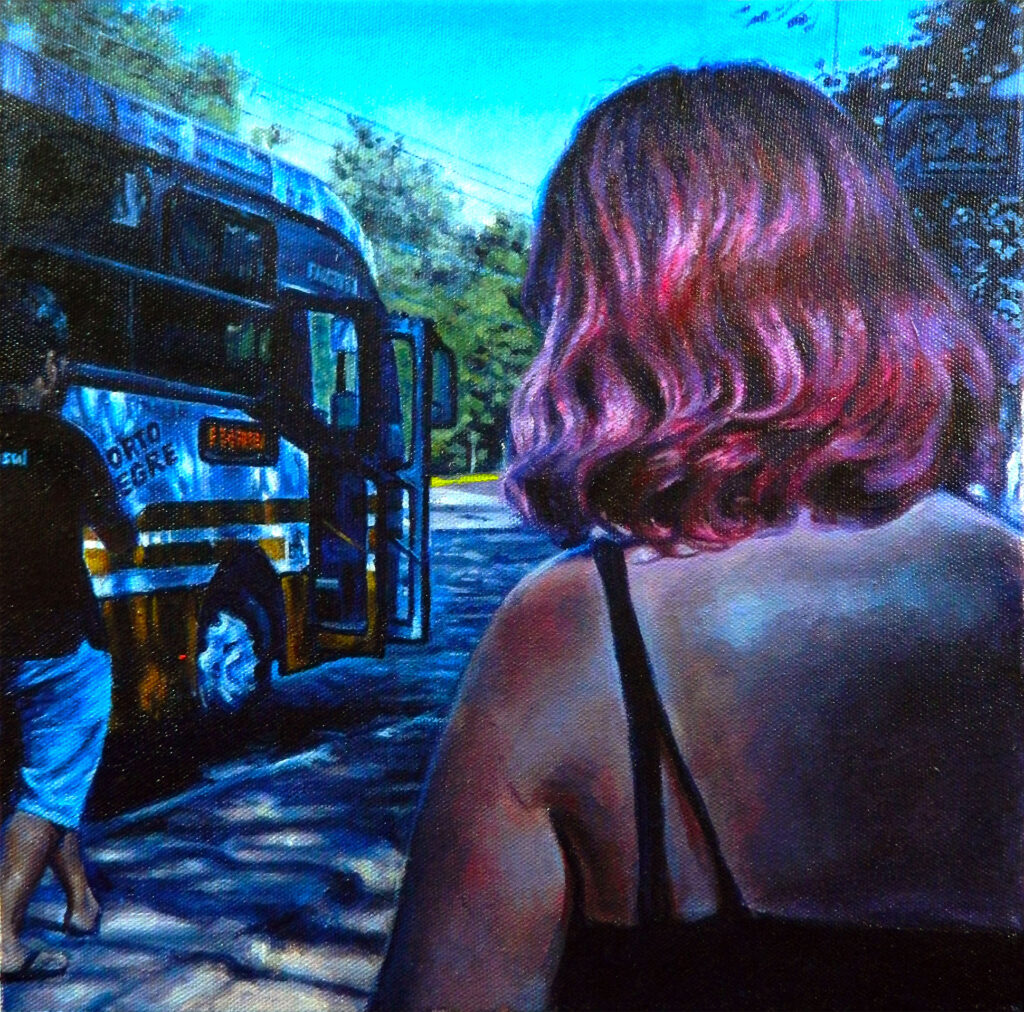
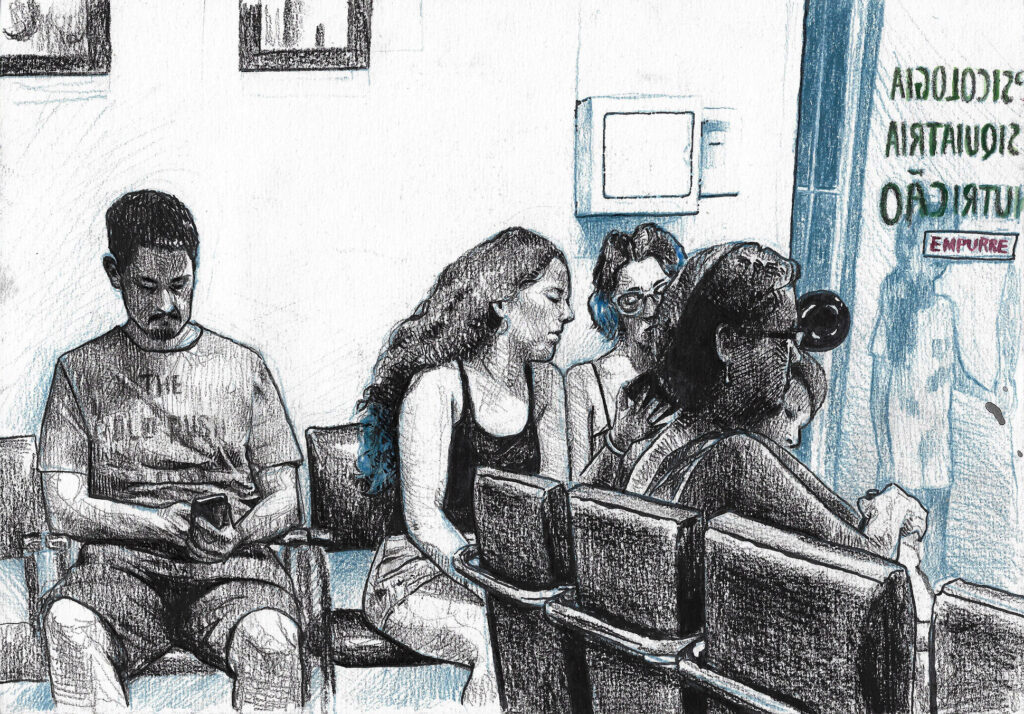
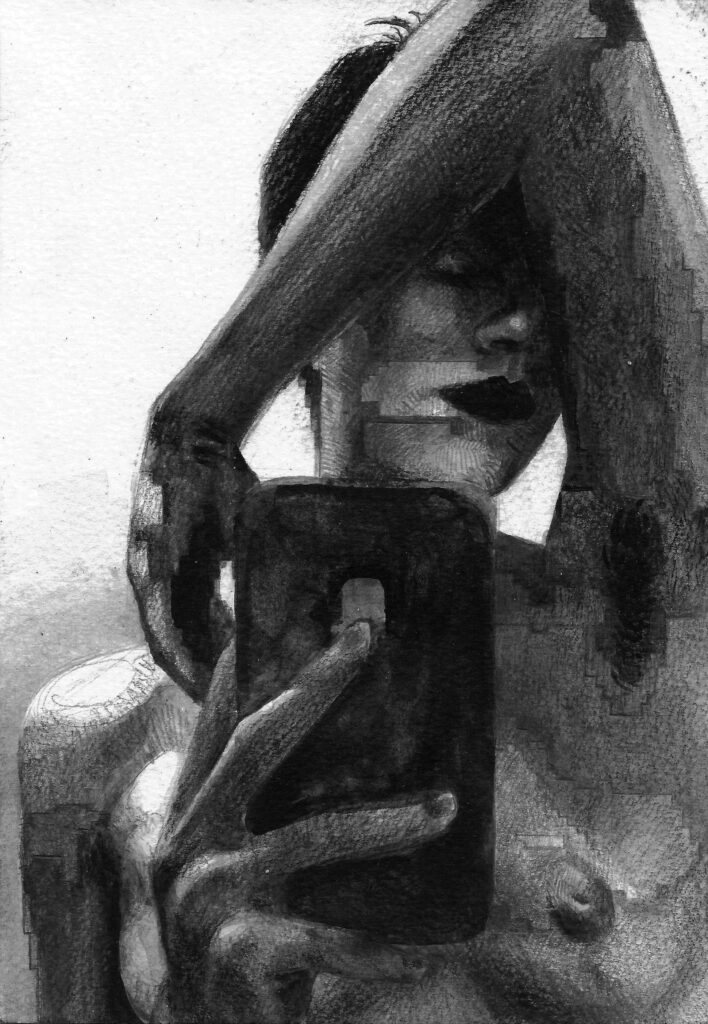
Marina Prudencio (Porto Alegre, 1996), a graduate with a Bachelor's degree in Visual Arts from UFRGS, is a visual artist focused primarily on acrylic painting, as well as graphite drawing and occasionally other media. Her pictorial and graphic language, typically figurative, tends to focus on themes of urban daily life, introspection, and visual metalanguage. She has participated in collective exhibitions: "Corpografias: Mapeando o feminino" (2018), at UNIPAMPA, Bagé; "Transitoriedades" (2018), at the Profª Alba Theumann Science and Culture Space, in the UFRGS Physics Institute; and the 19th National Art Salon (2022), at the Jataí Museum of Contemporary Art, Goiás. She held her first solo exhibition at the UFRGS Arts Institute, in the Ado Malagoli Space: "Transeuntes" (2019), a production that culminated in her namesake Graduation Thesis.
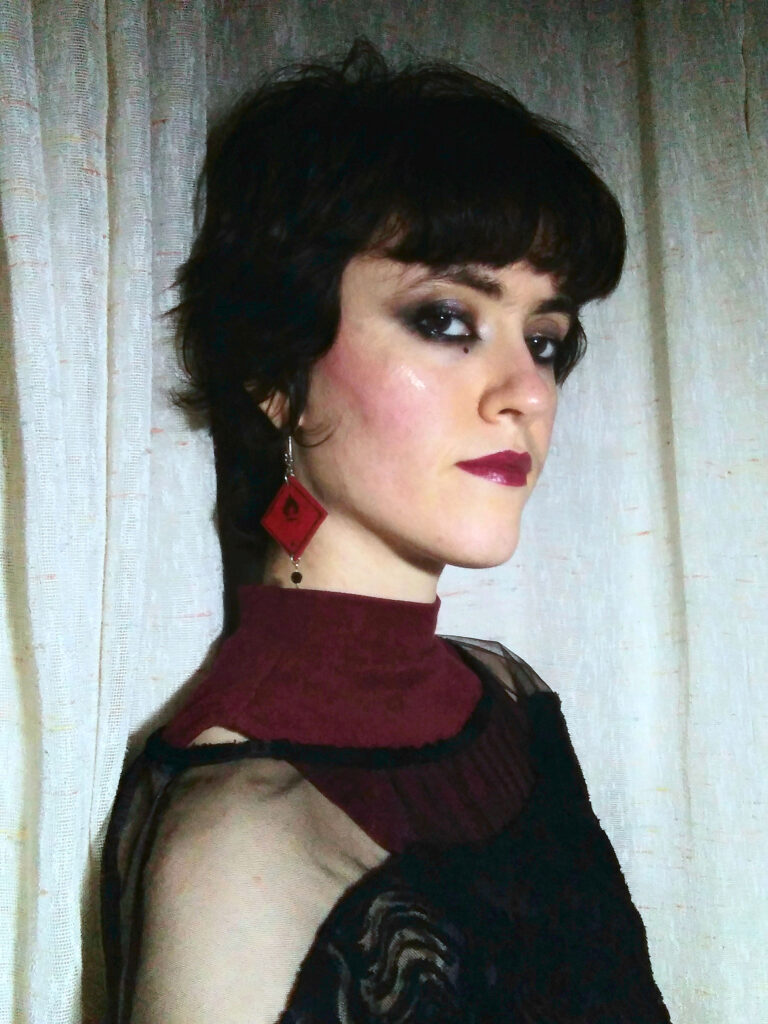
How did your journey into the art world begin?
I entered the Visual Arts course in 2015, completing it in 2019 under the guidance of Lilian Maus. Before that, my formal introduction to the visual world took place in the drawing course Correndo Risco, taught by Wilson Cavalcanti at the Atelier Livre of the Porto Alegre City Hall in 2013, the same year I finished high school. However, my interest in artistic creation began very early. In a way, discovering my own visual language went hand-in-hand with my formation as a person. Having been encouraged early on in my family environment, I had paper and pencil in hand every day. I only began attending museums and galleries after entering formal arts education in 2013; however, I have always been as much a fan as an artist, and it was through the internet that I first began to accumulate knowledge and admiration for the field by collecting image files.

What themes do you prefer to explore in your works?
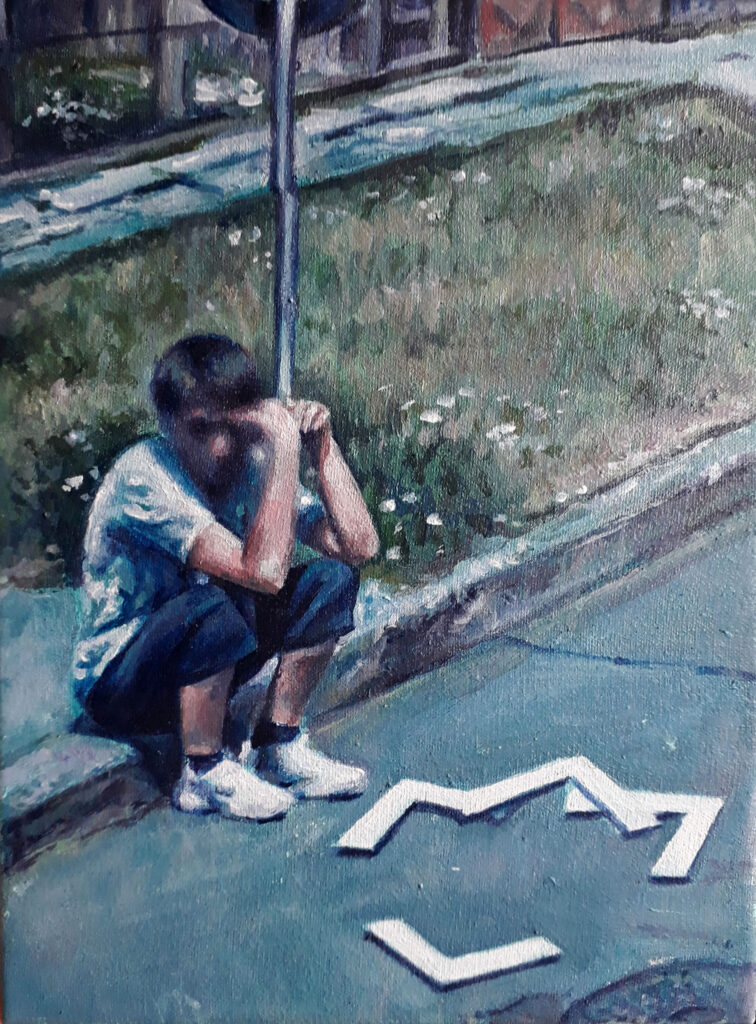
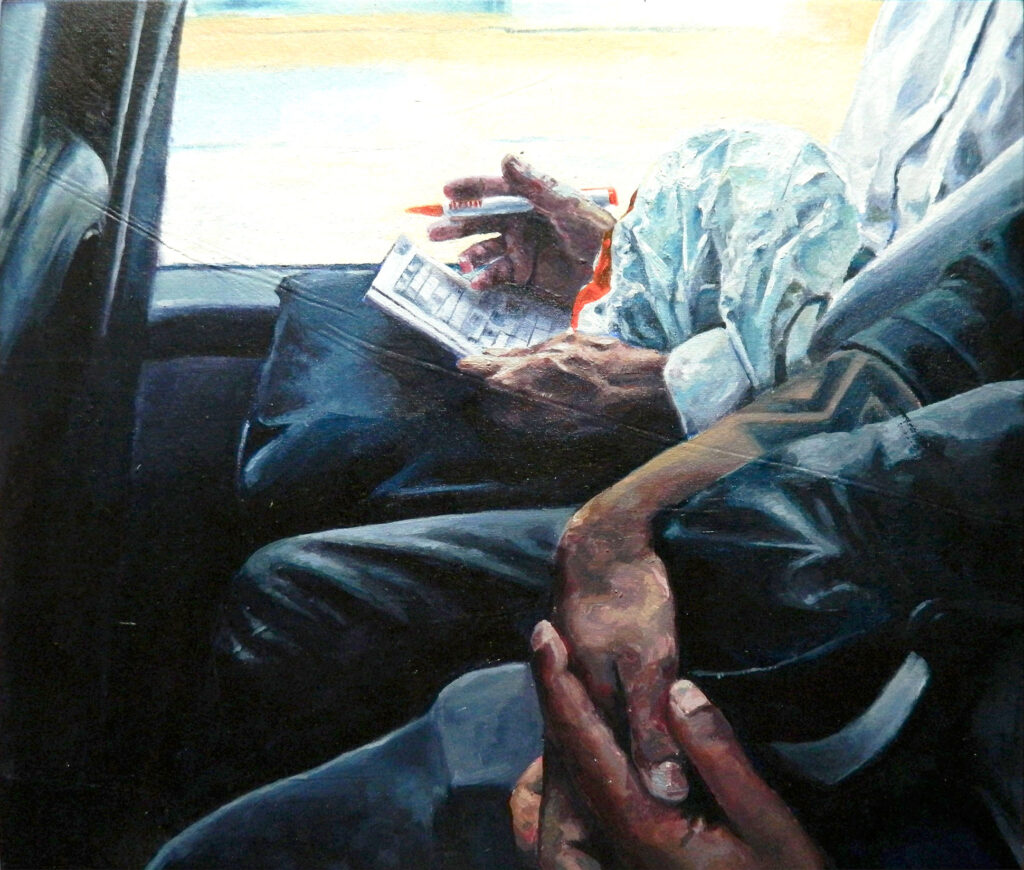
Since 2018, I have been exploring the issue of urban daily life through reference images that I captured clandestinely with my cell phone camera and reproduced in the form of acrylic painting on canvas. The starting point for this production occurred in a painting class taught by Lilian Maus at the Arts Institute—a professor who also advised me on my thesis, which included a large part of the production from that discipline. I also began to appropriate screenshots from the game GeoGuessr, which uses Google Maps Street View for exploration and guessing locations around the world. Besides thinking about how common technological devices assist in artistic creation, I also wanted to emphasize the distance we have from one another, even with physical proximity—how we can be in contact with the image of someone in their daily life on the other side of the world. The act of painting then becomes a kind of meditation on ourselves and our relationship with the "other" by slowing down the gaze; it also manifests as a reality filter: the filter (painting) of the filter (photographic images captured on mobile devices). Both the making and the contemplation of images become unique perceptions. After completing my thesis, the pandemic period occurred, and I turned back to my own image, emphasizing the introspective side that has always been present in my work; however, I never stopped thinking about the other.
What are your sources of inspiration?
My main source of inspiration is the daily life, the banal, and how it can be subverted through imagery transformation. Idleness is particularly inspiring, as it is where ideas can flow—unoccupied but, at the same time, rich in function and utility. Contrary to common perception, rest (or "doing nothing") is very useful and productive. In my works, there is much of what is called "doing nothing," whether riding public transport, waiting in a waiting room, or enjoying brief intimate moments with oneself or someone else. What art and idleness have in common is their contribution to a well-being that energizes us for when we need to use our bodies for subsistence.
What materials and techniques do you use most often?
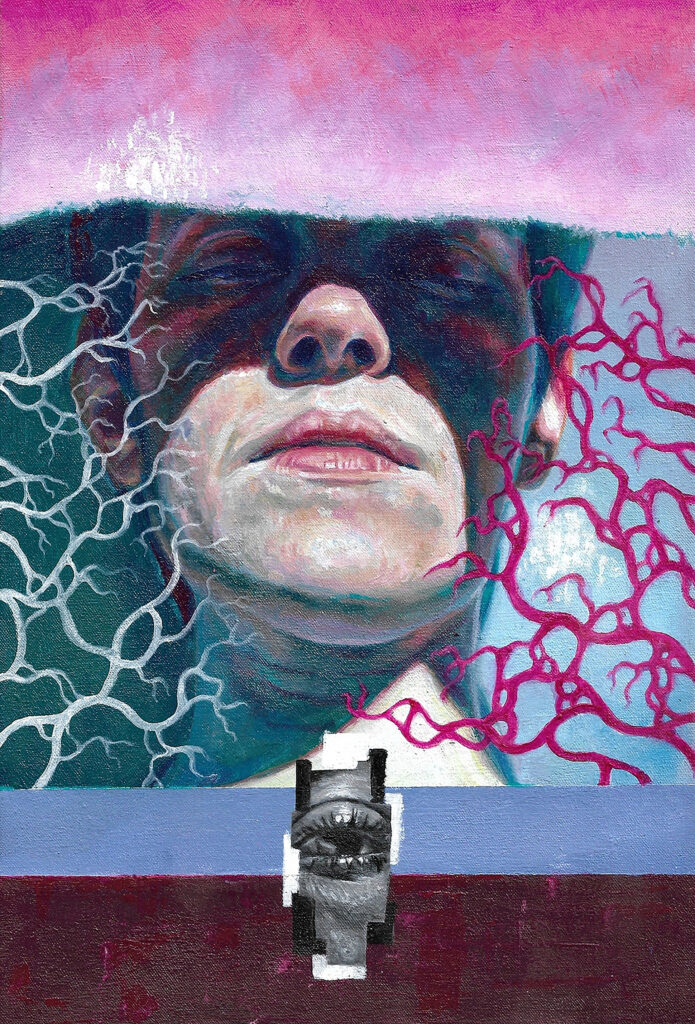
I usually use acrylic painting, particularly because it is convenient for a home environment like my studio, in addition to the material's fast drying process and versatility. I like to paint on canvases in several thin layers (increasing the thickness as needed, especially in the final layers) to create an image with "body" and complexity. Recently, I have returned to graphite drawing, which was my technique of choice before focusing on painting. I feel that the habit of painting has influenced my current drawing in the sense of building the composition in layers and not depending on immediate strokes. At least, that is my mentality nowadays: producing in smaller quantities and in a slower manner. However, I feel in perpetual motion and this may change. I like to draw on higher grammage papers, from 120g to 300g. I have been including the blending stump (esfuminho) to create a more diffused layer, reintroducing the pencil texture on top, and using charcoal at strategic points to darken and create a homogeneous texture. In some works, I experimented with drawing on recycled paper and varnishing part of the drawing, thus darkening and highlighting it with shine (which unfortunately cannot be well-contemplated in reproductions).
Who are the artistic influences that have impacted your work?
I would say I am influenced at every moment by a diversity of artists, with new ones always being introduced to the pantheon. Despite this, specific names can be cited. For my Transeuntes series, obvious names are Edward Hopper, through his paintings full of the silence of American modernity, and Vivian Maier, a photographer on the margins whose practice depended on nothing but herself and her urban scenes. Mauro C. Martinez is an important reference for thinking about the digital image in painting. I like the work of Daniel Coves for the tension and mystery represented in his faceless portraits (in my paintings, I usually hide the identity of the subjects). Speaking of tense portraits and, more specifically, self-portraits, those of Léon Spilliaert were an early influence on me and impact me in the way I usually portray myself. The window paintings of Zoey Frank awaken curiosity and contemplation in me, similar to those I have in daily life, but through a very spirited, orderly, and at the same time expressive filter. I also admire the expressiveness and sincerity in Käthe Kollwitz, even more so for representing the individual and social impact of her time. As for older artists, regarding technique, themes, and/or expression, I am influenced by Vermeer, Caravaggio, Goya, and Velázquez.
What is the role of the artist in today's society?
The role of the artist changes moderately according to the society in which they are inserted. In my perception, the artist currently leads us beyond a supposed utility. It is necessary to live beyond subsistence, and it is in art that we find spirit and motivation, whatever those may be.